An open secret in higher education is that most university faculty are not formally trained in teaching before securing their first job as a faculty member. The goal of most graduate programs is to produce excellent researchers.
However, teaching is paramount to the job of faculty and being an effective teacher is an important part of the reappointment, promotion, and tenure process. And as faculty at a land-grant university that enrolls over 40,000 students—including over 27,000 undergraduate students in fall 2025—we have a powerful opportunity to make an outsized impact on our student body and the broader community by approaching our teaching with the same rigor we bring to our research. We care deeply about teaching well, but how can we continue to improve while juggling multiple responsibilities and expectations?
The Office for Faculty Excellence spent the summer grappling with this question and how to better support our faculty who want to improve their teaching. The result is a top-to-bottom redesign of the Core Teaching Certification (CTC) that provides the fundamentals of teaching and course design, to ensure that every faculty member at NC State has the knowledge and resources needed for success.
How do I improve my teaching? What should assessments do? What helps students really learn? The redesigned CTC answers these questions through new instructional videos designed and produced in-house by the OFE team. You will also explore application examples and curated resources, and—through embedded application activities—make real progress on your teaching and course planning.
Moreover, in the new CTC, you will use established pedagogical frameworks to think through your approach to AI. Instead of prescribing a “correct” approach to AI—which seems unrealistic given the breadth of NC State’s colleges and departments—we offer a process for working through the possibilities and challenges posed by AI for learning for your specific course, and more importantly, space to work through them on your own or with your colleagues.
The CTC has been structurally updated to make it easier to fit into your schedule:
- You can sign up anytime. There is no application window or cohort start date.
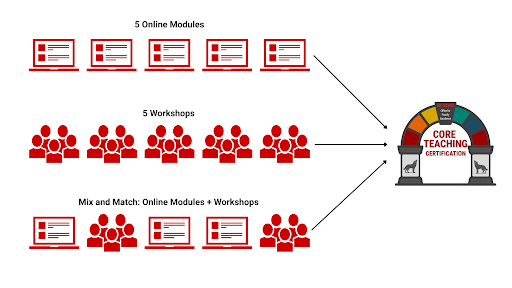
- The CTC has five modules that can be completed either 1) online or 2) by attending an in-person workshop designed around the module’s content.
- The online track is designed to be maximally convenient and completely self-paced. For connecting and discussing ideas with your colleagues, it is recommended that you attend a workshop, which will be facilitated by an OFE Faculty Fellow (this year: Justin Post).
- You are of course free, and encouraged, to do both.
- Completion of each module, online or through an in-person workshop, is recognized with a module badge.
- Earning all five module badges earns the certificate.
- You can mix and match online module completion and in-person workshops. All three paths below lead to the certificate:
- If you only want to complete the modules that interest you, the module badges will serve as proof of your accomplishment.
- If you don’t finish all five modules in an academic year, you can finish the following year. Module badges don’t expire.
The new CTC combines the flexibility of self-paced online modules with the lively community that workshops can offer. Whether you are new to NC State or have taught here for years, the CTC provides something valuable: dedicated time and space to reflect on and improve your teaching, so you can reach your students better and help them learn more. We designed it with intention and care, thinking about NC State faculty every step of the way. If you are interested, we hope you sign up. Your students will feel the difference!
Register here to enroll in the Moodle course, where you can decide if you would like to complete the certificate asynchronously online, attend in person workshops, or a combination of the two.
To attend any of the in-person workshops, please click on the links for each module to register.
- Module 1: Reflective Teaching
- September 24, 1-2 pm, Winslow Hall Conference Room
- Module 2: Designing for Understanding
- October 8, 1-2 pm, Winslow Hall Conference Room
- Module 3: Assessing Understanding
- October 22, 1-2 pm, Winslow Hall Conference Room
- Module 4: Designing Student-Centered Experiences
- November 5, 1-2 pm, Winslow Hall Conference Room
- Module 5: Evaluating and Refining Teaching
- November 19, 1-2 pm, Winslow Hall Conference Room (sign-up link)
For questions, please email [email protected].
- Categories: