Core Teaching Certification
The redesigned Core Teaching Certification makes it easier than ever to improve your teaching on your own schedule.
Great professional development shouldn’t feel like another item stacked onto an impossible to-do list.
The Core Teaching Certification is offered by the Office for Faculty Excellence (OFE) to empower faculty excellence through quality professional development programming that enhances faculty skills and practices.
The Core Teaching Certification is designed to provide support and recognition for faculty and staff members at NC State who are dedicated to improving and examining their teaching methodologies through reflective practice. Its goal is to help faculty members move toward becoming scholarly teachers. Scholarly teachers understand teaching as a profession with a distinct knowledge base in which they need to gain expertise. They reflect on their teaching, try new approaches, discuss ideas with colleagues, and explore the literature on teaching and learning.
The Core Teaching Certification provides three main opportunities for faculty to:
- Learn skills and information about teaching not necessarily gained during formal training in graduate school, helping them become more scholarly teachers;
- Gain recognition for their efforts to become more intentional, reflective teachers who incorporate best practices in teaching in higher education; and
- Collaborate with other faculty members outside their home departments who are dedicated to improving their teaching.
Upon completing the certification, faculty participants will be able to:
- Integrate reflective practices and strategies to continuously improve their teaching;
- Define clear learning objectives and create student-centered learning experiences using the Understanding by Design (UbD) framework;
- Design assessments that accurately measure student achievement of intended learning objectives;
- Plan learning experiences and instruction that engage and enable students to attain intended learning objectives;
- Gather and use feedback to inform and refine their teaching.
Who is eligible to participate?
Open to all NC State faculty, including professional-track faculty and part-time faculty. Postdocs who have already completed the Teaching and Communication certificates may apply for this certification. (Graduate students are not eligible at this time, but are encouraged to seek out many professional development opportunities offered by the Graduate School.)
Registration
Register here for the Core Teaching Certificate. Once you register, you will be added to the Moodle course on September 18, which contain all information to allow you to complete the certificate in whichever format you prefer (asynchronous online, in person or a combination). If you would like to attend any of the module workshops in person, you may register for each individual workshop below.
Certification Format
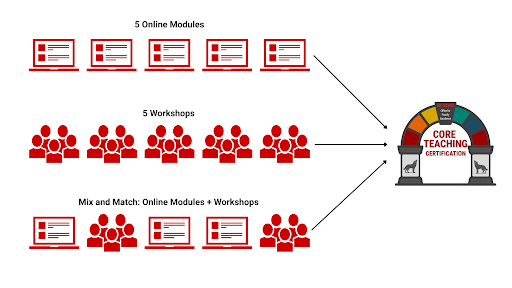
The Core Teaching Certification is hybrid-flexible and consists of five modules that can be completed 1) asynchronously online, 2) synchronously through in-person workshops, or 3) a combination of the two.
Faculty will earn a module badge after completing each module. Earning all five module badges will lead to the certificate.
Certification Pathways
Fall 2026 Workshop Schedule
For faculty who chose to complete the Core Teaching Certification by attending in-person workshops, the schedule is below.
- September 24, 1-2 p.m., Winslow Hall Conference Room
- Module 1: Reflective Teaching
- Module 1 Registration
- October 8, 1-2 p.m., Winslow Hall Conference Room
- Module 2: Designing for Understanding
- Module 2 Registration
- October 22, 1-2 p.m., Winslow Hall Conference Room
- Module 3: Assessing Understanding
- Module 3 Registration
- November 5, 1-2 p.m., Winslow Hall Conference Room
- Module 4: Designing Student-Centered Experiences
- Module 4 Registration
- November 19, 1-2 p.m., Winslow Hall Conference Room
- Module 5: Evaluating and Refining Teaching
- Module 5 Registration
Modules
- Reflective Teaching
- Faculty explore the benefits of reflective practice as well as models and methods they can use to incorporate it into their teaching.
- Designing for Understanding
- Faculty are introduced to Grant Wiggins and Jay McTighe’s Understanding by Design (UbD), a three-stage foundational instructional design framework, and learn to articulate clear learning objectives using UbD and Bloom’s taxonomy.
- Assessing Understanding
- Faculty explore the second stage of UbD: determining assessment evidence. Topics include aligning assessments with learning objectives, establishing assessment criteria and designing rubrics, checking for assessment validity, and considering AI in assessment design.
- Designing Student-Centered Experiences
- Faculty explore the third stage of UbD: planning learning experiences and instruction. This module introduces activities, strategies, and materials for creating engaging and effective learning experiences.
- Evaluating and Refining Teaching
- Faculty consider how they can draw on student, peer, and self-evaluation to reflect on and refine their teaching. This module also provides strategies for improving student response rates and getting stronger evaluations.
Each module includes a final activity for faculty to apply what they have learned to their own course planning, assessment design, and instructional design.
While the modules can technically be completed in any order, it is recommended that faculty complete them in numerical order for the best experience.
All online modules are currently hosted on Moodle, and are available to faculty as soon as they register and are added to the course. There is no deadline for completing the modules or the certification.
Upon completing the certification, participants will be asked to complete a brief program evaluation survey.
For additional questions, please contact us at [email protected].