NC State Conference on Faculty Excellence Poster Session 2026
Session 1
1.1 64 Courses, 1 Angry Email, and Everything We Learned About Accessibility at Scale

With NC State’s April 2026 WCAG compliance deadline approaching, Poole College volunteered to pilot Brickfield accessibility scanning across 64 high-enrollment courses. What followed was a crash course in scaling remediation—and in learning what actually works when you’re trying to change faculty behavior.
This poster shares our journey: the early workshop that backfired when faculty got defensive, the dean’s email that barely got responses, the “disaster” when bulk fixes on a live course led to an angry email CC’d to the dean, and the day our part-timer almost quit over 600 table errors in a single question bank. But we also share what worked: newsletters with urgent-but-breezy messaging, targeting root courses instead of copies, building relationships through weekly “rounds,” befriending GAs who see both student and admin perspectives, and using AI to turn days of tedious fixes into hours.
The result: 36 courses completed, 565 high-impact fixes, and a process we’re still refining. This poster offers practical lessons for anyone facing accessibility compliance at scale—what to try, what to skip, and what we wish we’d known from the start.
Presenters: Darshana Juvale, NC State University, Poole College of Management, Associate Director; Elizabeth Shamblin, NC State University, Poole College of Management, Instructional Designer; Cherie Vick, NC State University, Poole College of Management, Accessibility Specialist; Chris Lehman, NC State University, Poole College of Management, Instructional Media Specialist
2.1 Back to the Basics: Preventing Digital Technology Burnout in Teaching

Educators and students alike face constant pressure from evolving digital platforms, AI tools, and online interactions. While recognizing the value of digital technologies, this poster considers how low-tech, purpose-driven teaching methods may help mitigate digital technology burnout for both students and instructors. This poster will define tech burnout and share classroom practices, including handwritten annotation, journaling, and in-class Blue Book exams. These approaches emphasize critical reading, sustained practice, and embodied knowledge, while centering autonomy, accountability, and deeper engagement. Grounded in scholarship and professional experience, this poster provides hands-on strategies to reduce digital fatigue and foster professional practices that feel both meaningful and sustainable.
Presenters: Al Rodriguez, NC State University, Senior Lecturer, Department of English; Laura Waldrep, NC State University, Senior Lecturer; Bethany Van Scooter, NC State University, Lecturer
3.1 Becoming a Scholar in Public: Peer Review as Academic Identity Work in First-Year Writing

Peer review is a core practice in first-year writing classrooms, routinely used to support revision. However, beyond its practical function as a feedback mechanism, peer review also operates as an early disciplinary space in which students perform, negotiate, and rehearse the behaviors associated with academic writers—questioning, justifying choices, reading critically, engaging disagreement, and adopting an audience-oriented stance. These small social performances provide students with opportunities to “try on” scholarly identities that extend beyond solitary drafting and instructor evaluation
This poster displays the findings of how peer review shapes students’ understandings of themselves as academic writers and identifies which peer review practices most effectively support identity development, confidence, and belonging.
Presenters: Settle Monroe, NC State University, Department of English, Lecturer
4.1 Creativity in Conservation – Interdisciplinary Projects in a Large-Enrollment GEP Course

FW 221 Conservation of Natural Resources is a large enrollment Interdisciplinary Perspectives GEP course. The culminating project in the course asks students to create a product that pulls from different disciplines and is inspired by, a reaction to, a solution to, or a statement about one of the conservation topics covered in class. Past projects have included paintings of endangered species, marketing campaigns for sustainable cosmetics, a cookbook of recipes made with native plants, music compositions representing habitat degradation and restoration, blueprints for low cost efficient water purification systems, and video games that teach management of endangered and invasive species. The project allows students to showcase their skills and talents and to connect with the material in meaningful ways beyond the typical scope of a lecture class. Students present their projects in a showcase at Talley Student Center where they learn from and are inspired by the creativity and ingenuity of their classmates. I am interested in presenting this project at the Conference on Faculty Excellence to get feedback from other faculty on ways to improve the project as well as to discuss ideas for creative projects in other large enrollment GEP classes across campus.
Presenters: Lara Pacifici, NC State University, Forestry and Environmental Resources, Teaching Professor
5.1 Designing Faculty Learning That Sticks: Building a Foundational Educator Training Program

Faculty are often expected to excel as educators with little formal preparation for teaching. This interactive session highlights the design and launch of a foundational educator training program built to grow faculty confidence, consistency, and creativity in teaching, without adding to burnout. Designed for both new and experienced instructors, the program reframes faculty development as practical, flexible, and immediately applicable.
The poster showcases a modular, asynchronous professional learning model organized into three core modules and ten targeted topics focused on pedagogy, instructional delivery, and assessment of student learning. Rather than emphasizing theory alone, the program centers authentic teaching scenarios, guided reflection, and actionable strategies that faculty can apply directly to their courses. Grounded in adult learning principles, the program balances autonomy with structure to support meaningful engagement and sustained instructional growth.
This poster also outlines key design choices that drove faculty buy-in and participation, including topic selection, scaffolding, interactivity, and alignment with institutional teaching priorities. Viewers are invited to consider how a foundational program can serve as a springboard for deeper professional learning through coaching and advanced development pathways. This poster offers transferable ideas, design strategies, and inspiration for building or strengthening educator development initiatives that support teaching excellence at scale.
Presenters: Dr. Bria Wright, NC State University, College of Veterinary Medicine, Curriculum and Instructional Design, Instructional Designer
6.1 Growing a Community of Practice for Interdisciplinary Course Instructors

Interdisciplinarity is a critical component of NC State’s strategic plan; and faculty are central to achieving interdisciplinary strategic priorities. In December 2025, the Office of University Interdisciplinary Programs and leadership and faculty in CALS initiated a collaboration to review high-enrollment Interdisciplinary Perspectives (IP) courses and identify ways to support and enhance interdisciplinary learning opportunities for students at NC State. Specifically, we aim to develop clearly articulated goals and expectations to facilitate consistent, transparent communication to students enrolled in gateway IP courses across the Colleges of Agriculture and Life Sciences (CALS), Natural Resources (CNR), and Sciences (COS). Building on the tenets of the Student Experiences Program (SEP) national collaborative that was piloted in Fall 2025 by Faculty STARS program by OFE, OUIP, IE,and College of Engineering, we will implement multiple surveys to assess student and faculty experiences in IP courses and analyze responses to assess the impact of interventions on student self efficacy and sense of belonging, faculty professional development and promotion; and collective understanding of the value of interdisciplinary education.
Presenters: Erin McKenney, NC State University, Applied Ecology, Assistant Professor, Director of Undergraduate Programs; Shova Mishra, NC State University, Assistant Professor, Department of Entomology and Plant Pathology; Carolyn Young, NC State University, Department Head, Entomology and Plant Pathology; Levent Atici, NC State University, Professor, AVP for Interdisciplinary Faculty and Student Engagement, Office of University Interdisciplinary Programs
7.1 Helping Students Help Themselves: Getting Started with Nudge Interventions

Nudge interventions are small changes to the learning environment or gentle reminders that influence decision-making of students. Recently, using nudges has gained increasing attention in educational settings, with a growing body of research on nudging practice.
This poster describes several facets of student learning and engagement where nudging students can support student success. We describe several actionable approaches related to instructional communication, specifically with respect to verbiage and timing. We relate these nudges to motivational theories, placing specific nudges within broader frameworks including Expectancy Value Cost, Growth Mindset, Goal theory, among others.
By providing a clear, accessible overview of evidence-based practices for nudging, this poster aims to help instructors, advisors, and administrators get started with designing effective nudge interventions that empower students to make beneficial academic decisions while preserving autonomy.
Presenters: Joe Harrison, NC State University, Department of Statistics, Graduate Student;
Justin Post, NC State University, Department of Statistics, Teaching Professor
8.1 High-Impact Experiences in Graduate Education: Defining a Framework Through Graduate Student Employment
High-Impact Experiences (HIEs) are a well-established framework in undergraduate education, yet their application to graduate education remains largely unexplored. Existing scholarship and national models focus almost exclusively on undergraduates, despite the fact that many graduate learning experiences already resemble high-impact practices. This poster introduces an emerging framework for conceptualizing High-Impact Experiences at the graduate level, using graduate student employment (e.g., research and teaching assistantships, internships, and practicums) as a primary analytic lens. Drawing on institutional collaboration and national conversations, this work articulates how graduate HIEs align with and diverge from undergraduate models. We highlight core characteristics of graduate-level HIEs, including sustained engagement, mentoring and collaboration, authentic responsibility, structured critical reflection, and explicit attention to professional identity development and career preparation. The poster also describes the development of a graduate student survey designed to document participation in employment-based experiences, assess return on investment for professional readiness, and map experiences to graduate competencies and institutional learning elements. By centering graduate students’ lived experiences, this work lays the foundation for inclusive assessment, clearer definitions, and future scholarship on High-Impact Experiences in graduate education.
Presenters: Radja Chinoun, NC State University, Provost Office, Graduate Teaching Assistant, QEP; Dr. Rebecca Sanchez, NC State University, QEP Director; Holly Hurlburt, NC State University, University College, Associate Dean; Rhonda Sutton, NC State University, Graduate School
9.1 If You Build It, Will They Come? Measuring Student Preferences for Self-Paced Library Learning Resources

Self-paced library learning resources are a key part of instruction at scale. The Libraries’ Learn on Your Own webpage includes short instructional videos and interactive guides to help students develop research skills independently. With our library transitioning to a new Integrated Library System and discovery layer, some existing instructional content is no longer accurate, creating a need to redesign videos and update materials. In addition, usage data indicates room for improvement in student engagement, so we wanted to gather real student feedback before redesigning by selecting a format that prioritizes learners’ needs.
This presentation will highlight an ongoing user research project led by a team of librarians and one graduate student. We use two complementary methods. First, pop-up interviews in a library space gather rapid feedback about how students find learning resources, what topics they seek, and which formats they prefer, without showing examples in advance. Second, moderated usability studies using think-aloud protocols compare three formats for the same skill-based or concept-based task to evaluate clarity, engagement, and likelihood of use.
We will share our research design, early insights, and lessons learned about conducting feasible, scalable assessment work. Attendees will leave with actionable strategies to measure instructional impact and real student feedback on format preferences that prioritize learners’ needs.
Presenters: Alexis Boone, NC State University, University Library Specialist for Digital Teaching and Learning; Alison Edwards, NC State University, Librarian for Digital Teaching and Learning
10.1 Implementation of inclusive classroom strategies and academic performance. Is there a relationship?

Forging an equitable and inclusive classroom environment necessitates implementation of instructional strategies that address the diverse learning needs of all students, regardless of their academic abilities, socioeconomic and cultural backgrounds or learning styles. It is known that inclusive learning environment enhances students’ academic progress, however, the magnitude of this positive impact is still to be elucidated. The goal of this study was to investigate the relationship between implementation of inclusive teaching practices and academic performance. The following instructional strategies have been employed: student choice assignments; inclusive syllabus; open-note assessments and alternative grading. Assessment statistics and survey data compared in the courses/course sections with and without implementation of inclusive instructional strategies shown a significant increase in academic performance as well as significant improvement in students’ attitude about their ability to learn, motivation and overall sense of well-being.
Presenters: Natasha Butz, Meredith College, Department of Biology, Assistant Professor
11.1 Integrated Approach in Science and Research: Redesigning Curriculum for Collaboration, Innovation, and Public Impact

Scientific research increasingly occurs in interdisciplinary teams and requires communication with audiences beyond a single field (Callaos & Horne, 2013). Science students are often taught that communication happens after research is completed, after the data are analyzed and the paper is written. In practice, scientists communicate continuously as they evaluate research, collaborate across disciplines, seek funding, and present findings to public and professional audiences (Kuehne et al., 2014). However, many students are trained to write and present only within their own discipline, leaving them underprepared for interdisciplinary collaboration and public-facing research communication(Trench & Brian, 2023; Joachim, 2008; Maddalena & Reilly, 2017).
This presentation introduces an integrated curriculum model that brings together students from different disciplines and embeds communication throughout the research process. Grounded in Project-Based Learning (PBL), the curriculum uses interdisciplinary, project-based assignments to support students’ development of research literacy, data literacy, visual literacy, and public communication skills. Through connected, collaborative projects, students practice interdisciplinary teamwork and audience-aware communication, preparing them for research and early-career scientific work. This session will showcase assignment designs that foster interdisciplinary collaboration and audience-aware scientific communication.
Presenters: Fiona Wang, Ph.D., NC State University, Department of English, Lecturer; Jamie Larsen, NC State University, Director of Professional Writing Program; Sara Alexander, NC State University, Lecturer
12.1 Integrating GenAI in a 3D Modeling Course
Generative artificial intelligence (GenAI) is rapidly reshaping educational practice by lowering technical barriers and enabling educators to design adaptive, interactive learning tools without formal software development expertise. This paper describes the development and classroom use of an instructional support application created using Google Studio, designed to assist instructors in real time by answering student questions when immediate responses are unavailable. The application also supports teaching through interactive 3D content, allowing instructors to rotate models during instruction to enhance conceptual understanding.
A central contribution of this work is demonstrating how prompt engineering—rather than traditional programming skills—serves as the primary mechanism for designing, refining, and deploying the application’s functionality. This paper shows how educators can meaningfully leverage GenAI tools without technical backgrounds. This work underscores the potential of GenAI and prompt engineering to democratize educational technology development and empower educators to create responsive and interactive learning environments.
Presenters: Niloufar Bayati, NC State University, STEM Education, Graduate Teaching Assistant
13.1 LeaderChef: Developing Leadership via a Culinary Arts Experience

This digital poster introduces “LeaderChef,” an innovative High-Impact Experience (HIE) that transforms a professional kitchen into a dynamic laboratory for leadership development. While traditional leadership pedagogy often relies on theoretical models, “LeaderChef” employs a hands-on “cook-converse-connect” framework to bridge the gap between abstract concepts and real-world application. Over a 16-week semester, students engage in weekly three-hour sessions that combine expert guest chef observations with collaborative culinary challenges.
The course is designed as an interdisciplinary study, requiring students to synthesize perspectives from Organizational Psychology, Applied Ethics, and the Culinary Arts. Participants navigate authentic challenges such as high-stakes decision-making, stakeholder alignment, and team resilience under pressure. Deep learning is facilitated through “”The Kitchen Chronicles,”” a qualitative reflective journal, and a “”Leadership Recipe Card”” log that tracks quantitative skill improvement. The experience culminates in a Capstone Leadership Philosophy, where students articulate their growth in transferable competencies like emotional intelligence and strategic thinking. This poster highlights the course’s pedagogical scaffolding, the intentional fostering of psychological safety through communal dialog, and how this immersive model serves as a scalable template for innovative, inclusive teaching.
Presenters: Jackie Bruce, NC State University, Department of Agricultural and Human Sciences, Professor
14.1 Learning How to Teach: Year-by-Year

Pedagogy in Practice (AEC 630) addresses a critical gap in training for graduate students. Students enrolled in the seminar observe STEM classes, take notes on their experiences, and share their insights and questions about instructor course-design, classroom management, and other decision-making. We meet weekly to discuss foundational readings about inclusive teaching practices, backward course design, Bloom’s taxonomy, and course alignment. Students also meet with guest experts in teaching to learn more about pedagogy in practice and grow their professional education network. Across the semester, students “climb” Bloom’s taxonomy, first building an understanding of pedagogical practices and applying concepts to their own experiences in academia, then analyzing and evaluating courses taught at NC State before developing their own teaching philosophy statements. We design a poster for presentation as a collaborative artifact, redesigned annually to reflect how each cohort experiences mentorship in pedagogy and makes meaning of learning how to teach.
Presenters: Erin McKenney, NC State University, Applied Ecology, Assistant Professor, Director of Undergraduate Programs; Derek Hoffman, NC State University, PhD Student, Biological Sciences; Emily Sandberg, NC State University, PhD Student, Fisheries, Wildlife and Conservation Biology; Ben Witt, NC State University, PhD, Student Biological Sciences
15.1 Making Students Care About Victorian Studies

Not many students come to NC State University to study British Victorian Literature. How or why should students care? This poster reports on my efforts to provide hands-on, interactive, and creative workshops, arguing that we can make students care through acts of making. The poster shares a selection of making-based assignments and student projects, many of which have been supported by NC State University Libraries. These include reading and writing with feather quills by candlelight, carving linoleum blocks for image printing, recording snippets of audiobooks, attempting shorthand and telegraphy, and mocking up Victorian periodicals.
Such activities have been successful in engaging students with course readings, historical contexts, and critical frameworks. Yet these exercises can also produce care: not just about Victorian studies, but how students feel about their education, each other, and themselves. Studies of humanities-based making projects have found that their outcomes include community and student well-being. Ultimately, my students may not pursue Victorian studies, but, through it, may orient themselves toward an applied humanities, in which care still abides.
Presenters: Paul Fyfe, NC State University, Department of English, Professor
16.1 Microlearning for Building Career Competencies

This presentation discusses the details of the design and development of a new microlearning platform designed to support the professional development needs of graduate students and postdocs. Based on competencies identified in research by the National Association of Colleges and Employers, this microlearning platform offers students on-demand, short-form learning for strengthening skills in areas related to teaching, communication, leadership and general career readiness.
Significantly, microlearning represents a form of Competency-Based Education that enables students to customize their learning goals by pursuing targeted forms of learning that align with those specific competencies they want to develop. As students move through multiple microlearning chunks, they develop competencies that are tangibly represented through digital badges. Collectively, the badges comprise a type of ePortfolio that provide students with public ways for sharing evidence of specific skills and knowledge that have been developed over time, and therefore contribute to microlearning as a form of High Impact Practice. In addition, the on-demand, short-form experience that characterizes microlearing provides students with the flexibility they need for managing geographic and time constraints, and therefore widens the accessibility for more students to achieve their professional development goals.
Given the significant potential of microlearning for supporting graduate students’ professional development goals, this presentation describes the design processes and how they were guided by considerations such as beta testing results, usability concerns, and various technical and organizational challenges. It concludes by describing plans for future study.
Presenters: Phil Tietjen, Ph.D., NC State University, Graduate School
17.1 Moving From Static Content to Engaging Connection: Reimagining Advising with Micro-Video

As student engagement increasingly shifts toward brief, visually driven content, academic advising and student support practices must evolve to remain effective and inclusive. This poster presents an innovative advising model aligned with NC State’s Faculty Excellence framework, leveraging 90 to 120 second asynchronous “micro-videos” to address frequently asked advising questions.
Grounded in principles of flipped learning, Universal Design for Learning (UDL), and inclusive excellence, this approach reframes advising as a teaching practice that prioritizes accessibility, clarity, and relational presence. By replacing static FAQ text with concise captioned video explanations, advisors provide students with on-demand guidance in a familiar format while maintaining instructional consistency with a more personal connection. We highlight implementation strategies, examples of micro-video content, and potential benefits related to student engagement, advisor efficiency, and scalable instructional support. This model demonstrates a practical, replicable approach to excellence in teaching, mentoring, and student success.
Presenters: A. Nicole Mihnovets, NC State University, Department of Forestry and Environmental Resources, Assistant Teaching Professor and Undergraduate Program Coordinator; Tiana Elame, NC State University, Department of Forestry and Environmental Resources, Lecturer
18.1 Practice-Based Meaningful Assessment
During the 2023–2024 Scholarship of Teaching and Learning (SoTL) Institute, I developed a survey to examine students’ experiences in my water quality laboratory course. The goal was to introduce students to research-based learning by engaging them in designing, implementing, and communicating investigations grounded in course lab techniques. In response to student feedback, I revised the pre- and post-surveys twice to improve clarity and relevance. As my understanding of assessment continues to evolve, I am now critically reflecting on whether the data I am collecting meaningfully captures student learning. Specifically, I am questioning whether closed-ended survey items are sufficient or if incorporating more open-ended questions would provide deeper insight into students’ perspectives and learning processes.
Presenters: Angela Allen, NC State University, FER Department, Assistant Teaching Professor
19.1 Reimagining Math Instruction: Historical Storytelling as a Tool for Conceptual Coherence in Secondary Education
This qualitative case study examines how learning mathematics through historical can prepare preservice secondary mathematics teachers to teach with both conceptual rigor and cultural responsiveness. Situated in School Mathematics from an Advanced Perspective, a redesigned content course, the study explores how engaging with the history and culture of mathematics supports the development of professional knowledge aligned with the Association of Mathematics Teacher Educators (AMTE) Standards, with particular attention to mathematical meaning, learner thinking, and the social contexts of teaching. Guided by frameworks of teacher knowledge, the study asks how preservice teachers demonstrate growth in pedagogical content knowledge, curricular awareness, horizon knowledge, and knowledge of content and students while learning mathematics through socio-historical contexts. Data sources included lesson plans, written reflections, and interviews supplemented by instructional artifacts. Findings show that PSTs increasingly use historical narratives to anticipate misconceptions, design coherent learning progressions, and connect ideas across time and cultures. Notably, participants began to view themselves as mathematical “storytellers,” reframing mathematics as an evolving human endeavor rather than a fixed set of rules. This work highlights historical storytelling as a promising pathway for preparing teachers consistent with AMTE’s vision of rigorous, inclusive mathematics instruction.
Presenters: Kenya Lawrence, NC State University, STEM Teaching and Learning: Mathematics and Statistics Education, Goodnight Doctoral Fellow
20.1 Rethinking Assessment: Student Perceptions of Standards-Based Grading in General Chemistry

Traditional grading systems in higher education often emphasize compliance and test performance at the expense of meaningful learning and student motivation. In response, alternative grading practices such as standards-based grading (SBG) are growing in use as they have the potential to positively influence student learning. This qualitative comparative case study investigates undergraduate students’ perceptions of SBG in a general chemistry course at a small, private liberal arts college. Through semi-structured interviews and analysis of final exams, the study explores how students interpret the transparency of SBG and its influence on their motivation and learning. Results suggest that while SBG can enhance student engagement and promote deeper learning, successful adoption requires careful design and communication. This study contributes to the limited research on SBG in higher education and offers practical insights for educators seeking to implement alternative assessment methods.
Presenters: Jessica Thorpe, Meredith College, Department of Chemistry, Administrative Faculty
21.1 Rooted in Results: Evaluating Multi-Modal Pedagogical Techniques in Planting Design Education

Design education for planting requires balancing technical skills, ecological knowledge, and artistic expression. However, many models depend on static graphics, which can limit student engagement and long-term retention. Findings come from a collaborative study of two undergraduate courses taught over consecutive semesters, exploring how scaffolded, experiential learning methods support student outcomes. Using mixed-methods evaluation, student experiences were assessed through a survey with 5-point Likert scales and qualitative reflections. Instructional strategies were divided into four phases: foundational instruction in design principles and plant features; experiential skill-building through field-based learning; project-based work across different design scales; and integrated, site-responsive design emphasizing biophilic and ecological concepts. Results show positive learning outcomes throughout all phases, with a strong preference for hands-on learning. Activities like field trips and planting installations received the highest satisfaction ratings and were linked to increased confidence in planting decisions. Qualitative data also suggest that high-support learning strategies and creative exercises reduce academic anxiety and promote deeper understanding. These findings support a transferable framework for planting design education that combines technical accuracy, experiential learning, creative exploration, and reflection.
Presenters: Julieta Sherk, NC State University, Horticultural Science, Professor; Dallas Bretzman, NC A&T State University, Lecturing Faculty, Landscape Architecture Program
22.1 ScienceWeek: Simple, “Process of Science” Projects for Large-Enrollment Courses

The AAAS Vision & Change document describes six core competencies for undergraduate biology. These skills, though, can be difficult to apply in large-enrollment courses. This poster presents ScienceWeek, a small-group project in which students apply the process of science, from developing a question and planning methods, to collecting data and writing up results. The projects are all interdisciplinary, applying these methods to the students’ lives and interests. One instructor can easily manage projects for over 100 students in ~1 hour per week. Qualitative analysis indicates that ScienceWeek teaches students: 1) scientific “research” is different from, and more detailed and difficult than, internet research; 2) the most challenging and creative part of scientific research is designing the study; and 3) scientists’ work deserves greater respect.
Presenters: Jennifer Landin, NC State University, Biological Sciences, Teaching Professor
23.1 Similarities & Differences Between Inferential Statistics and Global Haiku

In this poster, we provide additional background and examples for our Feb. 2025 paper in Chance. By juxtaposing statistical estimates which strive to be precise and accurate, with haiku that are more often purposely ambiguous or have several nuanced meanings, we raise the idea that the main similarity between statistics and haiku is that both are a reduction in dimensionality. Statistics takes many data points to a single or a set of numerical summaries or coefficients in a model, while haiku places “moments in time” into 3-line verse to convey gist which may be multisensory and filled with the poet’s poignant feelings. To demonstrate this contiguity, we begin by introducing readers to pop-culture haiku and literary haiku with examples of both, then briefly refresh readers with the patterns of praxis in descriptive and inferential statistics. We provide examples of regression to illustrate dimension reduction and side by side boxplots in a biomechanical data. Additional similarities include: imagery (data visualization), hypothesis testing vs. 3rd-line of haiku, pairing and contrast. Next the current research use of AI in haiku is explored. Finally Stefanski-style residuals are examined.
Presenters: Charles Smith, NC State University, COS Department, Associate Professor; David McMurray, Kagoshima International University, Professor
24.1 Strength Training as Well-Being: Building Confidence and Preventing Future Muscle Loss Among College Students

Background: Student well-being in higher education is typically framed around mental health and stress management, while physical strength is rarely positioned as a core component of well-being or long-term health. Sarcopenia, the age-related loss of muscle mass, can begin earlier than commonly assumed, yet preventive behaviors are rarely emphasized in young adulthood.
Methods: Guided by the Health Belief Model, a cross-sectional survey assessed sarcopenia awareness, knowledge, perceived benefits and barriers to strength training, and self-efficacy among college students (final analytic sample: n = 177).
Results: More than half of students (51.4%) had never heard of sarcopenia, and only 11.3% demonstrated high knowledge. Despite low awareness, most students perceived strength training as beneficial (95% agree/strongly agree) and felt confident in their ability to learn resistance training (84.2% agree/strongly agree). Perceived barriers differed by race and ethnicity, including fear of “bulking up,” lack of knowledge on how to begin, concerns about access to equipment, and lower perceived susceptibility.
Conclusion: Findings suggest that barriers to strength training among college students are primarily educational and perceptual rather than motivational. Integrating culturally responsive, empowerment-focused strength training education into academic and wellness initiatives may enhance student well-being while supporting long-term muscle health.
Presenters: Brenda Watson, Ph.D., NC State University, Health and Exercise Studies, Assistant Teaching Professor; Ashley White, MS, NC State University, Health and Exercise Studies, Senior Lecturer; Joy Kagendo, Ph.D., NC State University, Health and Exercise Studies
25.1 Understanding What Makes Online Teachers Successful: Insights From K-8 Virtual Educators in North Carolina
As digital learning environments continue to expand across K-12 education, understanding how teachers perceive and support student engagement is essential for improving virtual instruction. This poster presents quantitative findings from a study of 24 K-8 online teachers in North Carolina and explores how teacher attitudes differ based on grade level and student ability groups. Data were collected using a structured survey instrument measuring teachers’ perceptions of emotional, behavioral, and social engagement, along with their reported instructional strategies for maintaining participation in a virtual setting.
Results indicate that while teachers value engagement across all dimensions, the strongest emphasis lies in behavioral engagement—particularly through clear expectations, interactive activities, and technology-supported participation tools. Differences emerged when teachers discussed students with below-average versus above-average ability levels, identifying challenges in sustaining motivation and tailoring instruction for diverse learners. Implications highlight the need for professional development centered on differentiation in online environments, engagement monitoring, and equitable instructional design.
This poster contributes to the broader conversation on effective virtual pedagogy by elevating teacher voice and offering research-based insights to guide training, preparation, and future innovation in online instruction.
Presenters: Danielle Cunningham, Durham Public Schools
Session 2
1.2 Effect of Exam Benchmarking and Retakes on Student Learning and Anxiety

High attrition of students from undergraduate STEM majors, especially from underrepresented groups, remains a major issue in STEM education. One reason many students drop STEM majors is because they receive a poor grade on high stakes exams in an introductory course. We are interested in using alternative testing strategies to improve student learning and performance on high-stakes exams. Students in select sections of General Microbiology and Introductory Biology were assessed using a non-traditional testing method, similar to standards-based grading. In these courses, students who reach a benchmark grade on a closed-book exam receive full credit for reaching proficiency. Additionally, students who do not demonstrate a proficient level of knowledge will get a voluntary retake attempt for the exam. Students were surveyed at the end of class to understand their thoughts on the testing style and its effect on their perceived learning and mental health. Data shows that students overwhelmingly found the testing style to be beneficial. They were able to review material they got wrong, better understood what they didn’t know, and had much lower levels of stress and anxiety around testing. We will discuss the format, structure, and pitfalls of the exam style along with the data and lessons learned from the student survey.
Growing a Community of Practice for Interdisciplinary Course Instructors Interdisciplinarity is a critical component of NC State’s strategic plan; and faculty are central to achieving interdisciplinary strategic priorities. In December 2025, the Office of University Interdisciplinary Programs and leadership and faculty in CALS initiated a collaboration to review high-enrollment Interdisciplinary Perspectives (IP) courses and identify ways to support and enhance interdisciplinary learning opportunities for students at NC State. Specifically, we aim to develop clearly articulated goals and expectations to facilitate consistent, transparent communication to students enrolled in gateway IP courses across the Colleges of Agriculture and Life Sciences (CALS), Natural Resources (CNR), and Sciences (COS). Building on the tenets of the Student Experiences Program (SEP) national collaborative that was piloted in Fall 2025 by Faculty STARS program by OFE, OUIP, IE,and College of Engineering, we will implement multiple surveys to assess student and faculty experiences in IP courses and analyze responses to assess the impact of interventions on student self efficacy and sense of belonging, faculty professional development and promotion; and collective understanding of the value of interdisciplinary education.
Presenters: Michaela Gazdik Stofer, NC State University, Biological Sciences, Associate Teaching Professor
2.2 Examining Learner Self-Regulation and AI Literacy Through Integration of Notebook LM Artificial Intelligence Chatbot in a Graduate Online Course

NotebookLM, an Artificial Intelligence Chatbot, was used as a thinking partner to engage 11 graduate students in an online graduate course simulating real-time conversations about adult learning theory. Self-regulation framework (Pintrich, 2000) and AI literacy framework were used to deductively code their reflections. This poster addresses the question “How does the use of Artificial Intelligence chatbot Notebook LM affect student AI literacy and self-regulation?”
Preliminary findings suggest that students’ interactions with NotebookLM most frequently elicited evaluative and motivational processes. Students often reflected on the quality, accuracy, and relevance of AI-generated outputs, as well as the perceived value and affordances of specific tool features. Cognitive and contextual phases of self-regulated learning were also evident, particularly in students’ monitoring of their understanding and their reflections on how NotebookLM, as an AI-mediated tool, both supported and constrained their existing learning practices.For example, one student noted, “I found its other tools, such as the summary video, really helpful for breaking down the content into manageable, specific pieces.”
Reference Pintrich, P. R. (2000). The role of goal orientation in self-regulated learning. In M. Boekaerts, P. R. Pintrich, & M. Zeidner (Eds.), Handbook of Self-Regulation (pp. 451–502). Academic Press
Presenters: Florence Martin, NC State University, Teacher Education and Learning Sciences, Professor of Learning, Design and Technology; Nia Liu, NC State University
3.2 Flavors of a CURE

Scientific inquiry at the bench, MB360 is a Course-based Undergraduate Research Experience (CURE) that provides students with research experience. This course has many flavors but is united by a common set of objectives. This work compares the assessments associated with each course objective across two sections of the course. Dr. Goller’s course focuses on microbial growth and metabolism, with an emphasis on lab safety and data management. While Dr. Mathews’ course involves students isolating bacteria that produce antibiotics. The learning objectives focus on students designing and executing research, as well as the practices involved in scientific research, including keeping a lab notebook and presenting their findings. Assessment in both courses emphasizes a student growth mindset and the development of scientific practices and scientific identity. While these are both microbiology courses, this poster outlines practices for designing assessments in CURE courses at NC State and facilitating sharing of teaching practices between instructors.
Presenters: Stephanie Mathews, NC State University, Biological Sciences, Assistant Teaching Professor; Carlos Golller, NC State University
4.2 Hands-On or On-Screen? Evaluating Video and In-Person Instruction for Teaching Turfgrass Equipment Calibration

Accurate calibration of fertilizer spreaders is a foundational skill for turfgrass professionals, directly influencing application efficiency, turf health, and environmental stewardship. Traditionally, these skills are taught through in-person demonstrations and hands-on laboratory instruction. However, the growing adoption of digital learning tools and hybrid teaching models has prompted educators to consider video-based instruction as an alternative or supplement for skill-based training. This study aims to compare the effectiveness of in-person versus video-based instruction for teaching spreader calibration in an undergraduate turfgrass management course. Students were randomly assigned to receive either hands-on instruction led by an instructor or a structured instructional video covering identical calibration procedures. Student learning outcomes were evaluated using post-instruction assessments, direct observation during calibration practice, and measures of assistance required. Results indicate that in-person instruction more effectively prepared students for laboratory applications, with approximately 12% higher assessment performance and a 60% reduction in requests for additional assistance compared to video-only instruction. While instructional videos remain a valuable supplemental resource for review and reinforcement, the findings suggest that hands-on instruction remains critical for developing technical confidence and proficiency.
Presenters: Qiyu Zhou, NC State University, Crob and Soil Sciences, Assistant Professor
5.2 Investigating the effects of competency-based education on achievement goal orientation of first-year veterinary students

Student motivation is influenced by many factors, including achievement goal orientation which describes whether a student is motivated to achieve mastery or to perform well on a subject. However, achievement goal orientation in veterinary students is not well studied. In veterinary education, the trend towards adopting competency-based education should, in theory, promote a mastery goal orientation.
To assess the effects of competency-based education on the achievement goal orientation of veterinary students, a survey-based study was initiated enrolling 32 first year veterinary students at North Carolina State University College of Veterinary Medicine. A questionnaire was sent at the start of the first semester to establish what achievement goal orientation students had at the beginning of their veterinary education. This survey showed that most veterinary students identified with a mixed goal orientation with a trend towards mastery orientation. For mastery-approach items, 89.6% to 100% of students responded positively. For performance-approach items, 37.5% to 81.3% of students responded positively. These findings are similar to a previous study on achievement goal orientation in veterinary students in a non-competency based curriculum. A second survey will be conducted towards the end of their second semester to determine if their achievement goal orientation has changed after participating in a competency-based curriculum for an entire academic year.
Presenters: Dr. Dany Meritet, NC State University, College of Veterinary Medicine, Associate Clinical Professor
6.2 Is teaching research different? Specialized knowledge used by Course-based Undergraduate Research Experience instructors

Course-based undergraduate research experiences (CUREs) have been championed for providing more opportunities for students to conduct research and make novel scientific contributions. However, we know little about how to effectively teach these laboratory courses to maximize student outcomes. Teaching a CURE is distinct from other forms of instruction as instructors must act as both a teacher and research mentor who flexibly respond to the needs of their individual students and their scientific inquiries. This requires instructors to draw from knowledge of students, of pedagogy, and of science as a practice to make real-time decisions about how to support students in doing research. We aimed to address this knowledge gap by characterizing pedagogical content knowledge (PCK) for teaching research or competency specific PCK. We conducted semi-structured interviews of experienced CURE instructors during which they reasoned through teaching scenarios that reflected common challenges students face in CUREs. We used deductive and inductive content analysis to understand 1) how instructors would respond to each scenario (instructor actions) and 2) the underlying knowledge they demonstrated behind their intended response (instructor knowledge). We characterized 25 different instructor actions aimed at supporting students in conducting science practices, accomplishing classroom tasks, and navigating the psychosocial dynamics of research. We also characterized six instructor rationale themes, including competency-specific PCK. Instructors drew from different knowledge bases (e.g., general knowledge about teaching, competency-specific PCK) when making decisions, even when using the same action. This study presents the first investigation of PCK for research teaching, expanding the construct of PCK to encompass competencies of science and describing how this construct manifests in CUREs.
Presenters: Lexie Cooper, NC State University, Biological Sciences, Assistant Professor
7.2 League of Soils: Using XR to Engage Students in Soil Classification

Soil science is an inherently field-based discipline, yet logistical limitations, such as large class sizes and student disability, prevent students in soil science lab courses from visiting outdoor sites. Without being able to observe and engage with the physical setting in which a particular soil exists, students struggle to make connections between environmental features and soil development.
We developed an augmented reality tool to create an immersive, virtual lab experience in order to improve student learning and provide a hands-on experience. Working with DELTA, we explored various virtual techniques, including 3D imagery and drone footage to meet our objectives. The collaborative process required faculty openness to experimentation alongside DELTA’s technical expertise in immersive media production and educational research. This willingness to explore multiple approaches together proved essential to developing an innovative solution.
Fall 2025 implementation across two soil science courses (n=105 students) demonstrated strong learning outcomes and high student engagement. The 360° soil pit view emerged as transformative: students consistently rated it “”very helpful”” or “”essential to learning”” for understanding soil horizon identification. Most significantly, 70% of students reported increased interest in actual field visits after the VR experience, suggesting virtual reality successfully sparked curiosity about fieldwork rather than replacing it. Implementation revealed important design insights about when immersive technology enhances learning versus when traditional methods remain superior. This session will showcase the virtual soil pit as well as what makes successful faculty-DELTA partnerships, encouraging attendees to pursue similar collaborations that bring pedagogical challenges and technical innovation together.
Presenters: Amy Johnson, NC State University, Department of Crop and Soil Sciences, Assistant Professor; Christina Kranz, NC State University, Department of Crop and Soil Sciences, Lecturer; Paul Couture, NC State University, DELTA, Educational Research; Ben Huckaby, NC State University, DELTA, Lead Interaction Designer/Developer
8.2 More Than a Headset: Designing Immersive Experiences to Enhance Experiential Learning

In an era where technology reshapes how we learn, virtual reality (VR) stands out as a powerful pedagogical tool that can deepen engagement and enhance experiential learning across disciplines. This presentation explores innovative uses of VR in health and wellness education. Attendees will gain insight into how VR can extend traditional classroom boundaries by complementing established teaching approaches, enhancing engagement, supporting experiential learning, and reinforcing key course concepts. Through a combination of practical demonstration, research highlights, and interactive discussion, this session will: (1) showcase evidence-based VR applications, (2) discuss best practices for integrating VR into curricula and co-curricular initiatives, and (3) outline strategies for assessing impact on learner engagement. Participants will leave with actionable ideas for designing immersive experiences that integrate seamlessly into their own teaching.
Presenters: Dr. Renee Harrington, NC State University, Department of Health and Exercise Studies, Associate Teaching Professor, Director of Undergraduate Programs
9.2 More Than a Playlist: Partnering with the Library to Transform LinkedIn Learning into a Teaching Tool

Move beyond passive use of LinkedIn Learning to active, integrated learning by selecting and customizing content to match specific course objectives, providing supplemental or remedial content for diverse student needs, and embedding content directly within Moodle to add your own assessments and verify learning beyond simple video completion. Learn how to identify high-demand industry skills on LinkedIn Learning that map to your course’s learning outcomes and use your course to help students stack skills and build a professional social network, bridging the gap between your curriculum and the professional world .Faculty and staff can also upload their own unique digital content to the LinkedIn Learning platform, making it discoverable to the wider NC State community!
Learn how the Libraries can help you explore creative uses of LinkedIn Learning to meet a variety of needs. We’ll share practical, technical tips, as well as current and aspirational use cases.
Presenters: Alison Edwards, NC State University, University Libraries, Librarian for Digital Teaching and Learning; Alexis Boone, NC State University, University Libraries, University Library Specialist for Digital Teaching and Learning
10.2 Podcast Pedagogy: Innovating Teaching and Learning Through Student-Developed Podcasts

Podcasts—edited content available online and downloadable as audio-only or audio-visual files—are an increasingly important way in which people learn about and engage with the world. In the last 20 years, podcasts have entered spaces of higher education as a unique tool across a several of disciplines, though their dominant pedagogical use has been as a means of communicating course content or connecting with wider audiences or knowledge producers. They have been used far less for and examined as student-developed projects for assessment. In this project, I provided student-produced podcasts as a learning project for assessment among 40 undergraduate students enrolled in Media Culture in Sport and Tourism. Results will be based on data currently being collected during the Spring 2026 semester. Early learnings for presentation will be discussed in the context of student-centered approaches to teaching and learning.
Presenters: Bryan Clift, NC State University, Department of Parks, Recreation, and Tourism Management, Assistant Professor
11.2 Prospective Mathematics Teachers’ Self-Efficacy and Integration of Inclusive Teaching Practices in a Field-Based Methods Course

Existing research suggests prospective mathematics teachers (PMTs) find enacting inclusive teaching practices challenging. Defined broadly, inclusive teaching can refer to Universal Design for Learning principles, differentiated instruction, and/or culturally responsive teaching practices. The goal of this study is to engage PMTs in using artificial intelligence to identify and enact specific inclusive teaching practices to increase their teacher self-efficacy. Participants in a field-based methods course completed a pre- and post-survey, wrote reflections, and developed a lesson plan. Data were analyzed to understand PMTs’ ability to design and enact lessons that incorporate inclusive teaching practices. Findings suggest participants feel confident in their ability to differentiate a math lesson and identify a variety of methods for creating inclusive teaching spaces. However, they choose limited strategies as they implement lessons in their field placements.
Presenters: Cyndi Edgington, NC State University, STEM Education, Associate Teaching Professor
12.2 Redesigning an MPA Capstone

Master of Public Administration (MPA) programs struggle with both choosing appropriate culminating activities (capstones, portfolio, comprehensive exams, etc.) and assessment of NASPAA-required competencies. However, this research describes and evaluates a new model of MPA portfolio specifically designed to both demonstrate skills targeted towards a graduating student’s employment goals and align with MPA program required assessment competencies. Using independently collected focus group data from both students and interviews with faculty holding assessment responsibilities, this poster identifies strengths and limitations of the new portfolio model as well as future steps to harmonize these processes better.
Presenters: Jay Rickabaugh, NC State University, Department of Public Administration, Assistant Professor; Jewel Tyler, NC State University, MPA Student
13.2 Rethinking Homework in the Age of AI: The Role of In-Class Collaboration

Traditional homework in engineering education is typically defined as individual out-of-class problem-solving assignments that are intended to reinforce course concepts. While homework remains an important practice tool, its effectiveness has been increasingly challenged by widespread access to solution websites and AI-based tools. This study examines an alternative approach that shifts problem-solving practice into the classroom through structured, instructor-facilitated collaboration. Two sections of MAE 201: Thermal Fluid Sciences were compared. In Spring 2025, 80 students completed traditional individual homework assignments. In Fall 2025, 70 students participated in collaborative in-class problem-solving sessions, working in small groups with active instructor guidance, immediate feedback, and peer-to-peer explanation. Results show consistent improvements across all major assessments in the collaborative model, including increases of 13.6% on Test 1, 10.5% on Test 2, and 23.2% on the final exam. Student feedback further indicated improved conceptual understanding, increased confidence, and greater ability to apply course concepts independently. These findings suggest that structured in-class collaboration can address limitations of traditional homework in the digital era while better aligning engineering education with the collaborative nature of professional engineering practice.
Presenters: Mary Zadeh, NC State University, MAE, Assistant Teaching Professor
14.2 Shaping Innovative Design Processes with Emerging Technologies in ID Education: A Studio-Based Wearable Design Case Study

This study examines how emerging technologies—3D body scanning, AI-assisted visualization, and parametric design—reshape learning experience and core competencies in graduate Industrial Design (ID) education. Through an eight-week studio project, students developed innovative wearables addressing evolving relationships among body, technology, culture, and environment. Through structured workshops and iterative studio activities, students applied 3D scanning for human-centered data acquisition, AI visualization (Vizcom) for rapid ideation, and parametric modeling (Grasshopper) for adaptable, algorithm-driven design development.
Using a mixed-methods approach, the study analyzed student outcomes alongside self-evaluation surveys and a reflective focus group to assess growth in key design competencies, including technology fluency, creativity, problem-solving, and human-centered insights. Findings indicate increased engagement, enhanced creativity, and greater efficiency in the design process, along with interest in broader technological integration (e.g., AR/VR) and interdisciplinary exploration. The study highlights a technology-driven pedagogical framework supporting hands-on independence, creative and systematic thinking, hybrid workflows, and a collaborative AI–human mindset, offering a pathway for preparing students to navigate uncertainty and complex systems in evolving socio-technological landscapes.”
Presenters: Yuanqing Tian, NC State University, Department of Industrial Design, Assistant Professor; Byungsoo Kim, NC State University, Department of Industrial Design, Assistant Professor
15.2 Strengthening Faculty and Staff Self-Efficacy for Equitable High-Impact Experiences
High-Impact Experiences (HIEs) promote student learning, engagement, and belonging, especially when implemented with inclusive and reflective approaches. Yet effective HIE design, delivery, and assessment depend on faculty and staff confidence and preparedness. Grounded in self-efficacy theory and national high-impact practice frameworks, this poster examines how professional development can strengthen institutional capacity for equitable experiential learning.
We share findings from a pre/post self-efficacy survey from the Packways Professional Development series at NC State University. The survey captured confidence across HIE competencies, including designing and delivering experiences, using critical reflection best practices, and recognizing and reducing barriers to access. Results show increased confidence across key competencies, particularly those tied to equitable implementation and reflective practice.
Open-ended feedback highlights the value of hands-on work time, peer collaboration, and clearer assessment expectations, and suggests improvements to workshop structure and follow-through. Implications and recommendations are provided for strengthening future PD and supporting sustainable, inclusive HIE implementation.
Presenters: Radja Chinoun, NC State University, Provost Office – Institutional Effectiveness, Graduate Assistant, Quality Enhancement Plan; Dr. Rebecca Sanchez, NC State University, QEP Director
16.2 Student evaluation of their peers in group based learning activities: A comparison of online and in-person learning scenarios

Online classes have become more mainstream today due in large parts to the adjustments that had to be made by universities and colleges during the CoVID-19 pandemic. Online classes are also popular among undergraduates due to their flexibility and convenience. However, some online classes still include group-based learning activities which require peer-to-peer interaction among students which could impact on these advantages due to differences in learning approach and schedules of the students. This study sought to compare students evaluation of their peers in group-based learning activities in online and in-person learning scenarios. To achieve this objective, we used collected from 212 students (137 online, and 75 in-person) enrolled in an introductory marketing class which required the development of a group marketing project. Students evaluated their group members’ contribution to the project by giving them a score from 0 to 5. Results show that there was a significant difference in peer evaluation score received in both sessions (p < 0.05). While students in the in-person session received an average peer evaluation score of 4.74, those in the online session received an average of 4.53 . Linear regression of the peer evaluation scores on enrolment method and other student characteristics showed that being in the online session resulted in a reduction of peer evaluation scores by 0.31 points (p<0.01).
Presenters: Edeoba Edobor, NC State University, Agricultural and Resource Economics, Assistant Teaching Professor
17.2 Student Perceptions of AI-aided versus Instructor-aided Composition Revisions

This project examines student perspectives on AI-aided versus instructor-aided composition revision in second-language instruction. As AI tools pervade learning environments, language instructors must adapt teaching methods with attention to potential drawbacks and benefits of AI as a writing partner. This study collects qualitative data from student surveys to gain insight into student perspectives on AI versus faculty as writing partners. Student writing samples will also be collected and analyzed for quantitative analysis of AI’s effectiveness in aiding students with grammatical accuracy and lexical complexity. The study examines how student impressions of AI effectiveness as a writing partner correlate with writing quality. Such information will aid instructors in deciding whether and how they may employ AI in teaching writing in a second language.
Presenters: Lauren Call, NC State University, WLC, Teaching Associate Professor; Juni Qureshi, NC State University, Undergraduate Student; Andrew Flores Martinez, NC State University, Undergraduate Student
18.2 Student Reflections on Literature Summaries by LLMs

This assignment was part of a 1st course for new graduate students in Biological and Agricultural Engineering focused on finding, reviewing, and summarizing scientific literature. One of their first assignments was to review and summarize a single paper related to their general area of interest. Subsequently they had the LLM of their choice revise their summary. Then they asked the LLM to summarize the same article. The last part of the assignment was to reflect on using the LLM, their challenges, frustrations, and any lessons learned. This poster summarizes students’ reflections on the process, the LLM’s response, and the usefulness of LLMs for writing tasks.
Presenters: John Classen, Biological and Agricultural Engineering, Professor
19.2 Designing a Structured GenAI Workflow for Research-Question Development
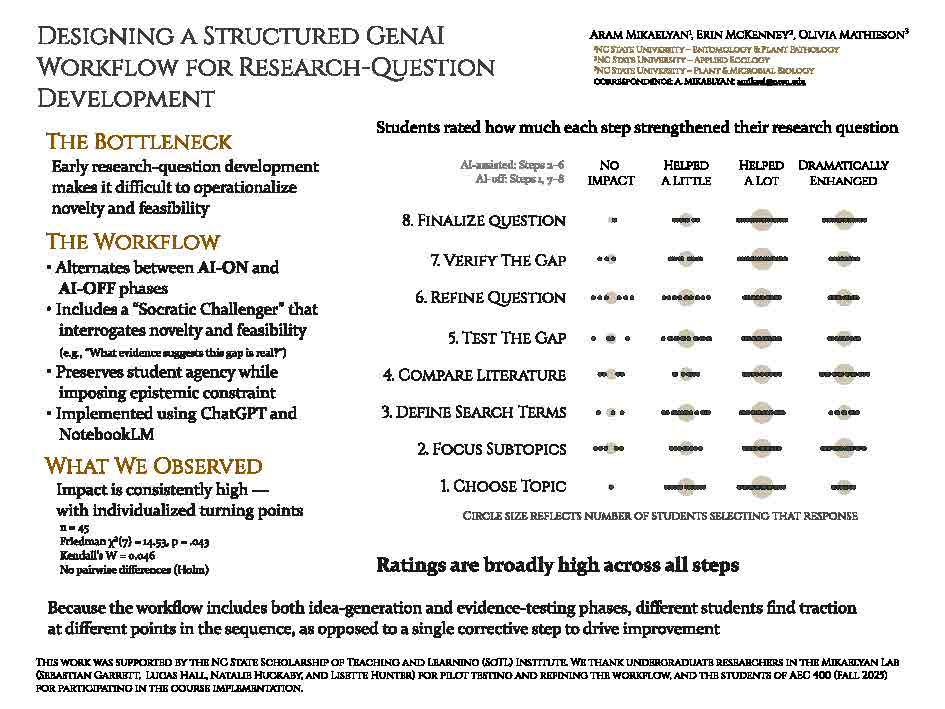
Generative AI is already embedded in student research and writing, yet many instructors struggle to design assignments that harness its benefits without rewarding unverified claims or outsourced reasoning. This session will seed a structured discussion by briefly presenting a generative-AI-enabled workflow that scaffolds topic-to-question development: narrowing scope, planning literature searches, synthesizing evidence, articulating gaps, and testing feasibility. I will share course evaluation findings from student ratings and reflections tied to the workflow components. Notably, students reported value across the workflow, but the component perceived as most helpful varied across individuals – suggesting that support needs are distributed rather than concentrated at a single bottleneck.
Presenters: Aram Mikaelyan, NC State University, Entomology and Plant Pathology, Associate Professor; Erin McKenney, NC State University, Applied Ecology, Assistant Professor, Director of Undergraduate Programs; Olivia Mathieson, NC State University, Plant and Microbial Biology, Graduate Student
20.2 The Reality of Virtual Reality: Enhancing Experiential Learning in Parks, Recreation, and Tourism

Virtual reality (VR) has long held promise as a way to transport students to immersive recreation destinations. Despite recent advances that have made VR more accessible, there remain few documented applications of VR within recreation education, and very little is known about how students experience recreation in VR. Our work sought to understand how undergraduates in a recreation and leisure course experience VR, to inform researchers and practitioners about effective ways to utilize VR.
Students visited a VR lab and used headsets to engage in three different types of VR recreation experiences: a 360 video of a Western North Carolina creek; a computer-generated forest scene using Nature Treks; and a virtual field trip using Google Earth VR. Together, these experiences outlined the different ways VR is commonly used in recreation.
Using a mixed-method design, we analyzed Instagram posts from 11 student small groups as informal reflections on their experiences, and conducted five semi-structured student interviews to dive deeper insight into their reactions. Four primary themes emerged: challenges related to equipment; surprise at the level of immersion; ways VR encouraged or complemented real-life recreation behavior; and a preference for 360 photos and video over computer-generated images. Overall, we observed that although few college students have prior VR experience, the technology can still be effective for supporting experiential learning and engagement.
Presenters: Dr. Nathan Williams, NC State University, Department of Parks, Recreation and Tourism Management, Teaching Assistant Professor
Dan Spencer, NC State University, DELTA, Research Scholar; Caitlin McKeown, NC State University, DELTA, Senior Instructional Designer; Alin Yalcinkaya, NC State University, DELTA, Postdoctoral Research Scholar
21.2 The Teacher in the Mirror: Can an asynchronous classroom management course impact teacher candidates’ self-efficacy?

The chronic teacher shortage in North Carolina can be attributed to shortfalls in teacher retention as much if not more than shortfalls in teacher recruitment. Developing resilience and self-efficacy can help buffer the stress of the profession and contribute to decreased perceptions of exhaustion in teachers and pre-service teacher candidates. In this poster, we will share the methods and results of a study exploring the impacts of an asynchronous graduate-level course on teacher candidates’ self-efficacy and resilience. We measured self-efficacy and resilience of students at the beginning and end of the course across two semesters with different modalities. We will share overall results and comparisons across groups.
Presenters: Jared Stewart-Ginsburg, NC State University, Teacher Education and Learning Sciences, Assistant Teaching Professor
22.2 Understanding Early College Students’ Experiences and Readiness in Social Work Education: Pedagogical Implications for NC State and Beyond

As the cost of higher education continues to outpace income growth, Early College High School (ECHS) programs have expanded as a cost-saving pathway to college. While these programs reduce financial barriers, concerns remain about the developmental and emotional readiness of younger students in college-level coursework.
At NC State, many ECHS students matriculate as juniors at age 18 or younger. In social work courses, we have observed that although ECHS students often excel academically, they may face unique challenges when engaging with sensitive or developmentally complex course content. These observations suggest a need for differentiated pedagogical approaches and tailored institutional supports. To better understand their experiences and inform responsive teaching and support practices, we are conducting two focus groups with undergraduate and master’s-level social work students. Using thematic analysis. This presentation reports preliminary findings and discusses pedagogical and institutional implications for NC State and beyond.
Presenters: Dr. Intae Yoon, NC State University, School of Social Work, Associate Professor; Dr. Natalie Ames, NC State University, Associate Professor; Dr. Stephanie Francis, NC State University, Director of Practicum
23.2 Using Digitally-Created Poster Project to Promote Engagement in Introductory Materials Science Course

Introductory Materials Science courses often enroll students from diverse engineering disciplines, making it challenging to sustain engagement while connecting abstract concepts to real-world applications. To address this challenge, a semester-long, technology-enhanced poster project was implemented to support student learning and engagement. Students investigated a material of their choice and created a professional-style poster using PowerPoint, reinforcing core course concepts with an emphasis on the relationships among microstructure, processing, and properties. Allowing students to select materials relevant to their intended engineering fields promoted personalized, application-driven learning supported by technology. Student reflections and poster submissions indicated that students valued the flexibility and autonomy of the project and reported an improved ability to connect material structure, processing techniques, and properties to practical engineering applications. Students also demonstrated increased engagement with course content and greater confidence in visually communicating technical information. This poster describes the design, implementation, and assessment of the project, highlighting how technology-supported, student-centered learning can enhance engagement and conceptual understanding in an introductory Materials Science course.
Presenters: Dr. Sharon Thorne, NC State University, Materials Science and Engineering, Teaching Assistant Professor
24.2 Where AI Can’t Reach: The Role of Special Collections in Fostering Critical Thinking & Primary Source Literacy

Teaching with primary sources offers a unique opportunity to use the original materials created during the period or event under study to teach concepts, develop critical thinking, and encourage a deeper connection to the past. Now, with the rise of AI, critical thinking is more vital than ever in academic instruction. While AI provides effortless access to synthesized information, it risks widening the gap in students’ capacity for critical thinking and nuanced interpretation of primary sources. In this poster, I will share the quantitative and qualitative results from a Scholarship of Teaching and Learning project involving 186 students across various disciplines conducted between August and November 2025. The study used a mixed-methods approach (Likert-scale questionnaire and open-ended feedback) to evaluate students’ perceptions of their special collections instruction sessions. Analysis of the Likert-scale results and open-ended comments consistently shows that engaging with physical primary sources, including examining physical features and making unexpected connections, significantly encourages students to analyze information more deeply and develop personal interpretations instead of relying solely on existing analyses. The findings offer powerful, data-driven advocacy proving that special collections are not just supplementary, but essential partners in developing 21st-century critical thinking skills that are fundamentally beyond the reach of AI.
Presenters: Shima Hosseininasab, NC State University, University Libraries, Special Collections Research Center, Instruction and Outreach Librarian for Special Collections
25.2 Who Owns the Output? Authorship Thresholds in 2D Sketch-to-Render AI: Evidence from Design Education

Sketch-to-render AI tools, such as Vizcom, let designers adjust how strongly their original sketch influences the AI output, from high (low AI reinterpretation) to low sketch influence (high AI reinterpretation). In this poster, findings from a Vizcom workshop study with design students (N=45) will be shared, mapping how AI-influence levels shift perceived authorship.
The key findings include: 1) where students draw the line between “my work” and “not my work” (authorship thresholds, which was clustered around the mid-range) and 2) how effort (two weeks of research vs. rapid ideation) prior to use the AI tool tightens or loosens design intent and changes what students accept from AI. A key takeaway is a practical “influence-band” framework for choosing AI settings by design phase. “
Presenters: Kim Byungsoo, NC State University, Graphic and Industrial Design, Assistant Professor; Haeyoung Kim, School of Design at Carnegie Mellon University; Yuanqing Tian, NC State University, Department of Industrial Design, Assistant Professor
Session and Poster Content Disclaimer:
The views and interpretations expressed in these presentations are those of the presenter(s) and do not reflect the views or official policy of NC State University or the University of North Carolina System.