Administrative Unit Assessment
Administrative units at NC State oversee academic and student support services, research, community/public service, and institutional operations. These units participate in the assessment process to sustain excellence and set goals for continuous improvement and institutional effectiveness.
Administrative units are the university’s essential infrastructure, carrying out critical, often invisible, functions to propel the institution forward. In an era of tightening budgets and high expectations, administrative assessment is an effective tool to help units continuously improve and be recognized as strategic partners that enhance the university’s mission.
Administrative assessment, guided by REG 02.90.02 and facilitated by Institutional Effectiveness (IE), is a systematic, internal process that equips units with the ability to reflect on the progress they make toward their desired outcomes and analyze the results from these measures to inform continuous improvement efforts.
Purpose of Administrative Assessment
Adopting a culture of assessment gives units clear, actionable advantages, providing a framework for data-informed decision-making.
- Telling the Story with Evidence: Units that implement an aligned assessment framework are equipped with evidence to provide leaders with powerful, data-driven narratives that justify resources and demonstrate continuous improvement.
- Driving Efficiency: Assessment empowers your team to find new solutions and provides a structured path to streamline workflows and reinvest staff time in higher-value work.
- Empowering Staff: Assessment isn’t top-down; it’s team-driven. It gives staff ownership over their work and a clear line of sight between their daily tasks and the university’s mission. It creates a culture of sustained excellence where staff are empowered to identify and act on improvement opportunities.
- Meeting Accreditation and Institutional Standards: Institutional accreditors (e.g., SACSCOC, CPHE) require evidence of administrative effectiveness (e.g., SACSCOC Principle 7.3). Assessment provides the documented, multi-year evidence (ideally 3+ years) needed to prove your unit is effective and mission-focused, moving this from a “check-the-box” task to a meaningful improvement cycle. It is also required by NC State Regulations (REG 02.90.02).
Institutional Effectiveness’ Role in Administrative Assessment
- Establish a Start Smart, Start Small Framework
IE demystifies assessment and makes it manageable. This means promoting a simple, repeating cycle where units assess only one or two key outcomes per year, with the aim of reviewing all outcomes over a 3-5 year period. This approach prevents units from feeling overwhelmed by focusing on small, manageable wins. - Integrate Assessment into Existing Workflows
To avoid creating a bureaucratic workload, IE will help units identify the data they already collect and use it for assessment. This includes providing updating report templates that can be integrated into existing annual reporting, rather than creating a massive, separate project. - Shift the Narrative from Compliance to Consultancy
Instead of positioning assessment as a top-down mandate, the goal is to be a strategic partner. IE will actively engage units with the assessment process and how it provides the powerful, data-driven narratives they need—framing assessment as a tool for them, not a report for accreditation. - Empower Staff and Foster a Team-Driven Culture
Assessment shouldn’t be the job of one person; it should be team-driven. IE will provide workshops and consultations that empower all staff to see the links between their daily tasks and the university mission. When staff are able to identify and act on improvement opportunities, assessment becomes a culture of sustained excellence rather than one person’s extra work.
Administrative Assessment Process
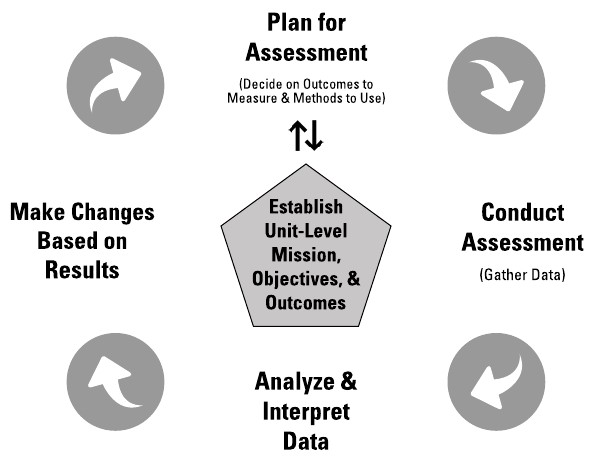
Create a Plan
Each unit maintains an assessment plan specific to that unit. The assessment plan lists the outcomes (goals) of the unit and also when and how each outcome will be assessed. Outcomes, as defined in the administrative assessment glossary, are detailed and specific statements derived from the unit’s objectives/goals. The outcomes should support the mission of the unit and NC State’s strategic plan. Units should assess at least one outcome per year, and assess all of their outcomes within 3-5 years. For more information about developing an assessment plan, refer to this assessment map resource. Section 1 of the annual assessment reporting template offers a guide for what an assessment plan entails.
Annual Assessment Reports
Assessment reports are submitted based on the unit’s operational calendar – academic, fiscal, or annual. The assessment report template is designed with feedback from NC State staff and administrators, and it allows for units to easily share information on outcomes/goal information from annual reports (as applicable). Administrative units should use Planning to submit annual reports by following the step-by-step guide (link to be added soon!).
Workflow and Timeline
Each administrative unit reports data, findings, and actions for the outcome(s) assessed. Reports are submitted using the following workflow:
- The unit contact collaborates with others within the unit as needed to complete the unit’s assessment report.
- The division head reviews the assessment report(s) from their unit(s) and provides feedback for revisions (if needed).
- The division head (or designee) completes a division-level summary report, responding to questions about the assessment process and how assessment findings are used for improvement.
- All administrative assessment reports and division-level summary reports are reviewed by Institutional Effectiveness and feedback is provided to each unit.
- Institutional Effectiveness provides an annual administrative assessment summary to institutional leaders.
Timelines for the workflow for each calendar can be found below:
| Workflow Step | Academic Calendar | Fiscal Calendar | Annual Calendar |
|||
|---|---|---|---|---|---|---|
| Submission of Assessment Report | June 30 | August 31 | January 31 | |||
| Submission of Leadership Summary | July 31 | September 30 | February 28 | |||
| Feedback from Institutional Effectiveness | October 31 | December 20 | April 30 | |||
| Annual Report to Leadership | May 31 | May 31 | May 31 |
Administrative Assessment Report Template
We have provided a template for administrative assessment reports, which are comprised of five sections:
- Section 0 – Executive Summary
- This section is optional, but can provide a useful overview of the report for leadership that may also be used for other reporting obligations.
- Section 1 – Assessment Plan
- This section includes a comprehensive list of the unit-level missions, outcomes, and a plan to assess all outcomes within a 5-year period.
- Section 2 – Assessment Report
- This section provides an overview of the two (or more) outcomes that were assessed during the assessment cycle. For each outcome reported on, there will be at least two measures that include data collection, results, and analysis and information on how results were reported and what actions are being taken based on the results.
- Section 3 – Future Assessment
- This section provides an overview of a unit’s plans for how the outcomes scheduled to be assessed in the next year will be measured and analyzed.
- Section 4 – Summary Report (Leadership)
- This section is to be completed by the department/division head or their designee. It includes providing information on how the results will be used in the upcoming year.
Support and Resources
Institutional Effectiveness provides guidance and workshops on the assessment process.
Individual consultations
A staff member from IE will meet with your unit to support any aspect of the process from writing outcomes and creating an assessment plan to writing and submitting the report. Contact Courtney Cullen more information.
Workshops
Virtual workshops are offered on topics including Administrative Assessment 101, Writing and Revising Outcomes, and Assessment Report Writing, implementing the assessment management software (Planning), and office hours. Learn more and register for upcoming sessions on the assessment resources page.
Resource Documents
The following documents are designed to help you navigate administrative assessment.
Contact Us
Institutional Effectiveness (Institutionaleffectiveness@ncsu.edu).
Courtney Cullen, Director of Assessment (cscullen@ncsu.edu)