
NC State faculty, staff and students — the new academic year is here! First, though, let’s see what you and the rest of your Wolfpack family have been up to over the summer. You’ve traveled around the world, undertaken groundbreaking research, served your community and much more. Take a look at everyone’s summer activities and maybe gain some inspiration for your next adventure.
Office of Global Engagement


This summer, NC State students and faculty took their learning far beyond the classroom—immersing themselves in the cultures, communities and industries of Cuba, Spain and Japan.
From exploring Havana’s vibrant history, to engaging with youth and community projects along Spain’s Camino de Santiago, to studying innovation and global business in Nagoya, these programs foster cultural competency, career-ready skills and personal growth.
Global One Health Academy

Kristen Sullivan, GOHA Director of Undergraduate Programs was in Prague, Czech Republic this summer to teach her summer abroad course, GOH 302: Global One Health Applications. Over three weeks, students explored how human, animal, plant and environmental health are deeply connected—and how these relationships play out in real-world settings across the Czech Republic. The course brought together a fantastic group of students — including the first cohort of Global One Health Scholars. Class outings took the group to the State Veterinary Institute, the Czech University of Life Sciences, a water treatment plant, community-based climate initiatives and more. These experiences offered a window into how One Health challenges are being addressed across sectors. Along the way, students also explored the history, culture and landscapes that make the Czech Republic such a unique and compelling place to learn. GOHA sends their thanks to the amazing team at the NC State European Center for their support — and to our students for making this such a memorable and meaningful experience!
Innovation and Entrepreneurship
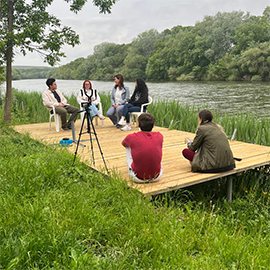
This summer, the Entrepreneurship Clinic partnered with Social and Sustainable Innovation and Entrepreneurship to send one of their student teams to meet in person with their international project partner, EduJoc, a Moldovan educational organization. While in Moldova, the team presented their learnings from the Entrepreneurship Clinic class, explored entrepreneurship in a different country and further developed a long-lasting relationship with Global Entrepreneurship Network (GEN) Moldova.
IR-4 Project

This summer, the IR-4 Project team was busy in the field, researching potential pest management tools to help specialty crop growers produce healthy harvests. In June, a group of headquarters team members traveled to Washington, D.C., to lead colleagues from the U.S. Environmental Protection Agency on an annual specialty crop tour. We toured an incredible mushroom farm in Maryland; a Rutgers University research station looking at solar cropping and robotic weeders; a fruit packing plant; and a New Jersey wine grape and peach orchard. Our work here at NC State is greatly enriched by the connections we nurture across the innovative land-grant network and with our federal partners at the U.S. Department of Agriculture and the EPA. As always, we spend our summer gearing up for fall events; all are welcome to join us at the Food Use Workshop or Environmental Horticulture Workshop to help shape IR-4’s next specialty crop pest management research priorities!
Laboratory for Analytic Sciences

This summer, a collaborative initiative at NC State’s Laboratory for Analytic Sciences (LAS) marked the fourth year of work towards solving a grand challenge proposed by the intelligence community: how can we generate tailored daily reports (TLDRs) for knowledge workers that capture information relevant to their objectives and interests?
The 2025 Summer Conference on Applied Data Science (SCADS) brought together 39 participants from academia, industry, and the government for eight weeks to address the persistent problem of “too much data, not enough time.” This year saw a convergence of past efforts into a single, end-to-end software framework called OpenTLDR. Participants made advancements in tailored recommender systems, automatic summarization and retrieval methods, and human-computer interactions.
Park Scholars


Sohini Das and Alexis Chan, both Park Scholars in the class of 2027, participated in a sprintership at Google. Their team built a conversational AI tool called Google Realtor to help individuals find places to move. Just say “2 beds, 1 bath under $2K near good tacos in Durham.” Their bot understands context, extracts details and remembers user preferences. They brought neighborhoods to life by integrating Google Places API for nearby schools, parks, restaurants and local gems, and layered in U.S. Census demographics and Google Solar API to show users who their neighbors might be and their home’s solar energy potential.
Isaac Carreno, Park Scholar in the class of 2026 and NC State student body president, interned for both for the Congressional Hispanic Caucus Institute and Congressman Pete Aguilar.
Niveda Mahesh, Park Scholar in the class of 2027, is interning at Procter & Gamble in Cincinnati. She and Kristin Williams, a longtime volunteer with the Park Scholarships program, connected and Kristin has been supporting Niveda.
Cole Malinchock, Park Scholar in the class of 2026, presented his first published paper at the IEEE Intelligent Vehicles Symposium (IV) 2025 in Cluj-Napoca, Romania. His co-written paper, “Q-Loc: Visual Cue-Based Ground Vehicle Localization Using Long Short-Term Memory,” introduces a vision-only method for global localization by using only a monocular camera and deep learning, without relying on GPS or LiDAR. This work explores how autonomous ground vehicles can estimate their global position based on visual landmarks in the environment.
Sarah Khan, teaching professor and Park Faculty Scholar for the class of 2027, completed a study abroad program with students in Nagoya, Japan. The focus was on business Information Systems and operations management. Sarah detailed her experience here.
N.C. Plant Sciences Initiative

With the goal of preparing a future-proof workforce at the intersection of plant science and artificial intelligence, NC State’s GRAD-AID for Ag program got off to a great start this summer, with nine Ph.D. students exploring N.C. farms and agricultural technology and analytics companies and taking part in a weeklong academic camp.
The innovative National Science Foundation-funded research traineeship equips students with the ability to integrate lab-derived multi-omics datasets with field data, leveraging the statistical analyses, machine learning, artificial neural networks, and other artificial intelligence approaches to accelerate translation of basic plant science research to the field. By the end of their training, the fellows will have completed the requirements for NC State’s Ag Data Analytics Certificate.
NC State Staff Senators and Wellness Champions

On July 25-27, a group of NC State Staff Senators and Wellness Champions embarked on a Western NC Service Trip to the Black Mountain Home for Children, a nonprofit organization supporting children and youth in foster care. The trip was organized through the Staff Senate’s Community Engagement and Outreach Committee, inspired by a commitment made last fall to continue supporting Western NC communities following Hurricane Helene. Volunteers spent the weekend delivering school supplies and toys, completing service projects on the home’s main campus, and connecting over shared meals in the beautiful mountain town of Black Mountain. The trip was a meaningful example of Pack members coming together in service to others, living out NC State’s Think and Do spirit.
Sankar Arumugam
Professor, Department of Civil, Construction, and Environmental Engineering
College of Engineering
Meagan Kittle Autry
Director of Graduate Professional Development and Associate Teaching Professor, Department of Civil, Construction, and Environmental Engineering
College of Engineering

We traveled to three cities in India to lead workshops for their subseasonal-to-seasonal forecasting National Science Foundation AccelNet grant project. We led a three-day technical workshop at the Indian Institute of Tropical Meteorology in Pune for hydrology and climate change graduate students and postdocs. Next, we led two-day early career researcher workshops at both the Indian Institute of Technology Bombay and the Indian Institute of Science, two of India’s top universities. The goal of the grant project is to increase the uptake of forecasting services for S2S forecasting globally to help mitigate issues of flooding worldwide.
Lillian Brumback
Undergraduate Student, Management First Year
Poole College of Management

This summer I participated in an international studies course that took place over two weeks in Prague, Czech Republic. We focused on viewing and analyzing globalization from a variety of interdisciplinary perspectives, both historically and in current issues. This class helped me understand the global networks that connect us, a crucial perspective for my supply chain management career focus. In addition, I got to explore Prague with other incoming freshmen, meet new friends, and experience a new culture, all while learning about the history, customs and language of the Czech Republic.
Kirsti Cole
Professor, Department of English,College of Humanities and Social Sciences
Co-director, Campus Writing and Speaking Program, Office for Faculty Excellence

This summer, I made significant progress on multiple scholarly and pedagogical fronts. I finalized and submitted an article on invisible labor to the Journal of Higher Education and advanced a related coding workshop and visualization resources on faculty workload. I also submitted an article on multimodal and AI communication a writing studies journal, drawing on my graduate ENG 583 course. My co-authored scholarship included a piece on gender and weight stigma with Dr. Valerie Renegar, and a chapter on ADHD and academic motherhood for an edited collection with one of my Ph.D. students.
I redesigned a graduate course in writing studies theory for fall 2025 to align with historical and contemporary composition theory, including GenAI pedagogy. I also developed a faculty-facing workshop for the International Writing Centers Association Summer Institute, “Writing with, not for, AI,” and began building a digital Moodle course for faculty certification in writing, oral, and digital communication. In grant work, I submitted a DELTA proposal and collaborated on plans for a National Science Foundation-funded project on ethical AI and information literacy. My professional travel included leading an institutional advocacy session at the Conference on College Composition and Communication 2025 and planning a future study abroad program on global sustainability communication in partnership with engineering faculty. I attended the International Writing Across the Curriculum conference in July to lead a workshop, present forthcoming research, and accept the Enduring Program award on behalf of the Campus Writing and Speaking Program.
Praneswar Ghosh
Graduate Student, Department of Crop and Soil Sciences
College of Agriculture and Life Sciences

Managing phosphorus is a delicate balance for farmers—too little can hurt yields, and too much can harm waterways. I’m working to make that balance easier. Under the guidance of Debjani Sihi, an N.C. Plant Sciences Initiative (PSI) faculty affiliate in the Departments of Plant and Microbial Biology and Crop and Soil Sciences, my research focuses on developing a faster alternative to the lab-based soil analyses that farmers currently rely on. In partnership with the N.C. PSI, NC State Extension, and the Science and Technologies for Phosphorus Sustainability (STEPS) Center, I am developing a method that uses a color-changing reagent paired with a portable color sensor to provide accurate phosphorus measurements in the field within minutes. STEPS Managing Director Maude Cuchiara leads the effort, with Cooperative Extension agents Sam Marshall, Karen Blaedow, Douglas Clement, and Meghan Baker collaborating through an N.C. PSI-hosted agent network.
These agents are working alongside three NC State undergraduate students—Elliot Kohn in the College of Natural Resources, Anna Garner in the College of Sciences, and Nathaniel Rhein in the College of Agriculture and Life Sciences. The team is collecting soil samples from across Western North Carolina, sending them to the University of Florida for full lab analysis, while I test them using my field-based method. Comparing these results will help determine the accuracy of the tool. If successful, this approach will allow farmers to check phosphorus levels at multiple locations on their field instantly, allowing them to manage their phosphorus use in ways that improve their bottom line and protect the environment. Phosphorus is a nonrenewable resource, and we must manage it wisely. With this method, farmers will be able to make more informed, site-specific management decisions in real-time that both support their productivity and protect the environment.
Shannon Hoffman
Administrative Support Specialist, Department of Agricultural and Human Sciences
College of Agriculture and Life Sciences

A good friend and I took our mules for a four-day trip to Dismal Creek in Pearisburg, Virginia. We camped at White Cedar Horse Camp. We rode each day on some beautiful trails and visited Dismal Falls, one of the most beautiful falls and areas for blooming wildflowers and different kinds of vegetation. On our last day there we climbed 3,100 feet to an overlook on a mountain with several radio towers! Spectacular!
Lindsay Hughes
Advisor, Study Abroad Office
Office of Global Engagement

Almost 10 years ago, I had my first study abroad (and international) experience, which changed my life and led me to my career in international education. For two weeks this summer, I was lucky enough to study abroad again as a part of my master’s program through the Spain: Culture and Community Engagement in Barcelona and the Camino de Santiago program! I got to be a study abroad student again—engaging with the community in Barcelona by working with local schools and nonprofits, navigating public transit and using my language skills, learning from my fellow program participants, and hiking more than 60 miles of the Camino de Santiago!
I get to work with students every day as they prepare for their own transformative study abroad experiences, but I don’t often get to see the impacts during/after. To get to witness this incredible group of students bond with each other, increase their cultural competence and step out of their comfort zones, making lifelong memories— while also having these experiences myself—in real time was a special reminder of the importance of international education that I won’t soon forget.
Jai Jackson
Assistant Vice Provost for Academic Administration
Office for Faculty Excellence

This summer, I participated in the second year of the 2024–26 Research Seminar on Affirming and Inclusive Engaged Learning for Neurodivergent Students, sponsored by the Center for Engaged Learning at Elon University. Together with colleagues from Rutgers University, the University of Michigan, and Ulster University in Northern Ireland, our multi-institutional team is sharing initial findings from our first year of mixed-methods research exploring systems, supports, and pathways that enable neurodivergent students’ access to high-quality engaged learning experiences. During this summer’s residency, we are refining our focus and designing a more sharply targeted research agenda for the coming year, with the intention of advancing systematic change in higher education to support neurodivergent learners in and beyond academia. Next summer, we will reconvene at Elon University to share our year-two results, plan the continuation of our work, and participate in a conference on affirming and inclusive engaged learning to amplify the impact of our research across institutions.
Mopel Kitele
Undergraduate Student, Department of Electrical and Computer Engineering
College of Engineering

Read Mopel’s story here
My name is Mopel Kitele, and I am an electrical engineering major with a passion for robotics and embedded systems. I transferred into this beautiful institution in January of last year, and I could not have foreseen the sheer amount of growth that I have experienced in such a short amount of time. When I transferred into this school, I did not know how to code, I did not know how to solder…I didn’t even know what Linux was. To be frank, I was slightly overwhelmed by the feats my fellow classmates were already achieving at the time. I felt like I was not doing enough. Instead of letting this feeling consume me, I transmuted it into a catalyst for growth. Even though I mentioned feeling odd at times, this school has connected me with some of the most powerful people I have met in my life. I say they are powerful because they care about their life, they are unwilling to settle for what it currently is now, and we all know that NC State can make us into whoever we want to be. Objectively speaking, this institution has the resources to propel you into legacy. We recognized this and decided to bite off the biggest pieces of steak the school has to offer. Simply because they were there.
The first great challenge was taking ECE 306 with Professor Jim Carlson. I tell you this now, I wouldn’t have taken that class if I didn’t have the solidarity of my dear friends to propel me through the darkest night. This class is known for “being the reason ECE is so hard”, but I want everyone to know that nothing is hard or impossible if you genuinely believe in your own ability to perform. The best way to gain bona fide confidence in your ability is to build momentum by taking note of every challenge you overcome, no matter how minuscule it may seem; it reassures you that you can do great things.
That leads me to what I did this summer. During finals season this past spring, I decided to take my 306 car to Dr. Donggun Lee’s office and show him its capabilities. Dr. Donggun Lee is the director of NC State’s Intelligent Controls Lab, where we develop novel control algorithms and packages to improve the current state of human-robot interaction and machine autonomy. Upon showing Dr. Lee my car, by the grace of God, he accepted me into his lab! I was extremely fulfilled with myself, because I knew if I didn’t take that risk to either fail or become great by the daunting blade of ECE 306, then this certainly would not be my reality in the present moment. I knew I had the power to influence my own life greatly.
Starting this past May, I have been working diligently under Dr. Lee in the Intelligent Controls Lab, where I have had the privilege of working hands-on with real autonomous robots. My primary focus was deploying a Model Predictive Path Integral (MPPI) Controller on the Indro Scout Mini, which is an all-terrain mobile robot equipped with LiDAR, an Inertial Measurement Unit, and a stereo camera. I dissected and compartmentalized a modular ROS 2 stack that containerized the robot’s perception, control, and navigation systems using Docker, enabling the robot to localize itself and avoid obstacles in real-time. This work culminated in my research poster that I was able to present at the NC State ASCEND REU Symposium that was held on Friday, July 25th.
The state of my intellect when I entered the lab compared to now vastly differs. I taught myself bash scripting, which allows one to navigate and operate a terminal. I learned about Linux from a developer’s perspective, which can be likened to opening Pandora’s box. I delved into the intricacies of Docker… It is such a beautiful piece of software that I highly recommend anyone with an interest in coding should grab the reins. I studied the Operating System known as ROS2, one may think of this as iOS, but for robots. These are the foundational techniques and scriptures that I was tasked with mastering before I could begin my true summer duty of deploying the Model Predictive Path Integral Controller.
All in all, it can be said that this summer I continued to learn, but not in the traditional sense. I sharpened my stance as an autodidact, and I will never back down from this position. As human beings, we can all push our current limits of comprehension by finding the intersection of curiosity, passion, and societal value and choosing to show up every day.
P.S. I learned how to kickflip as well.
Bianca Meotti
Graduate Student, Department of Civil, Construction, and Environmental Engineering
College of Engineering

This summer, I had the opportunity to intern at the National Center for Atmospheric Research (NCAR) in Boulder, Colorado, working with the Atmospheric Chemistry Observations and Modeling Laboratory. The internship was made possible through a collaboration with the Kenan Institute for Engineering, Technology and Science Climate Leaders Program. Over the course of three months, I used the Multi-Scale Infrastructure for Chemistry and Aerosols (MUSICAv0) model to study the impacts of power sector emissions on air quality and public health in Texas. My project focused on integrating high-resolution emissions data into MUSICA using diurnal emissions profiles to improve the model’s accuracy in capturing regional air pollution patterns. Our goal was to explore how advanced atmospheric chemistry modeling can inform more equitable energy policy decisions. This experience aligns with my doctoral research and fosters ongoing collaboration with NCAR scientists.
Kirsten Paige
Associate Teaching Professor, Department of Performing Arts and Technology
University College

I spent this summer completing several research projects. My first book, Richard Wagner’s Political Ecology, went into production this summer. It will appear in spring 2026 with the University of Chicago Press, considered to be the “world’s premiere book list in musicology.” I also completed a co-edited special issue of the Cornell-based journal Keyboard Perspectives, which explores global histories of keyboard instruments. That volume, which I both co-edited with Cornell/Oxford-based musicologist Morton Wan and contributed an essay to, will appear in October 2025. Finally, I drafted a new article on ideologies of music criticism, which I will submit to the Journal of the American Musicological Society by the end of the summer. I will be on leave this coming academic year as a Fellow in Garden & Landscape Studies at Harvard University’s research center, Dumbarton Oaks. While at Dumbarton Oaks, I will complete preliminary work on my second book, Keyboard Botany. This research is also supported by a major grant from the American Council of Learned Societies.
Kanton Reynolds
Director of Undergraduate Programs and Associate Teaching Professor, Edward P. Fitts Department of Industrial and Systems Engineering
College of Engineering

The UK STEM/Liberal Studies program had an eventful summer in London! The annual NC State Alumni Reception that I hosted on behalf of the program saw 11 former Wolfpackers join the students to talk about their expat experiences in the United Kingdom. The group represented three different decades from 1990 through 2020.
The program was also highlighted by several experiential learning experiences, including a visit with the British Red Cross to understand how they assist communities in need by providing relief and medical supplies under constrained circumstances. The students also had a chance to engage in cultural exchanges, visit historical transportation infrastructure sites and participate in a materials testing lab demonstration at Kirkaldy’s, one of the world’s first such testing facilities dating from the 1800s.
Amy Rossi
Director of Development Communications, Office of Development Communications and Stewardship
University Advancement

This summer was a big one. In late July, I held finished copies of my debut novel, The Cover Girl, in my hands for the first time. August 5 was the official publication date from MIRA/HarperCollins and the culmination of a lifelong dream. That same day, I was fortunate to celebrate my book launch at Quail Ridge Books, with fellow member of the Wolfpack Staci Kleinmaier moderating a discussion and a strong NC State presence in the audience. The university has shown me and this book an extraordinary amount of support, and I’m so grateful!
Madilyn Smith
Social Innovation Fellow and Undergraduate Student, Department of Animal Science
College of Agriculture and Life Sciences

As a junior majoring in animal science with a concentration in veterinary bioscience, and with minors in wildlife science, marine science and poultry science, I spent this summer working with Matt Fox, director of the Social and Sustainable Innovation and Entrepreneurship Program. Through a three-month fellowship from May to August, I explored how entrepreneurship can support recovery in Western North Carolina following the devastation of Hurricane Helene in 2024. In late May, we traveled to the region to witness the hurricane’s impact firsthand and engaged with local leaders, including NC Cooperative Extension specialists, Pisgah National Forest officers, artists, small business owners, a nonprofit animal rescue group called the Transylvania Animal Alliance Group, and the Western North Carolina Nature Center. After returning, we developed three project ideas for entrepreneurship students: improving online marketing for River Arts District businesses, increasing tourism at Chimney Rock and supporting soil health for local farms. We’ve since reached out to several universities, including Duke University, the University of North Carolina at Chapel Hill, Fayetteville State University, Davidson University, Winston-Salem State University, Campbell University and Western Carolina University, to build student partnerships across the state. This collaboration aims to expand the reach of our projects and deepen student involvement in community-driven innovation. The experience has given me lifelong skills in leadership, cross-disciplinary teamwork, and creative problem-solving that will serve me well in both veterinary and environmental fields.


