
Each year, the Global One Health Academy funds an exceptional group of graduate students with One Health related research interests. During their one-year appointment, the Global One Health Fellows are offered many opportunities, such as professional development workshops, networking with One Health professionals and more! Learn more about Lydia Sellers and how the Global One Health Fellowship helped support her important research on resilience education, emphasizing the impact that natural disasters have not only on physical environments, but also emotional, social, and community health.
What do you research?
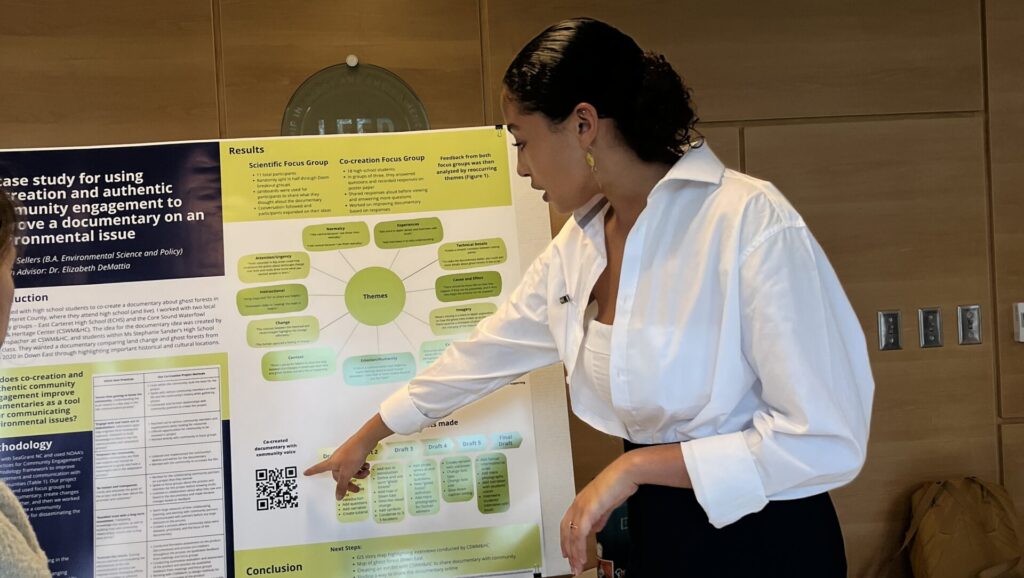
My research explores how resilience education can strengthen both environmental and human well-being. I focus on Ready, Set, Resilience (RSR), an interdisciplinary curriculum that helps children learn about resilience through nature, story, and community. The program is built around the idea that lessons from the natural world can teach us how to adapt and recover from change. Through the RSR curriculum, I study how stories from nature help children understand how both ecosystems and people adapt to change. RSR uses these nature-based stories, along with movement and reflection, to help kids see resilience not as a single skill, but as something that exists across systems: personal, ecological, and communal.
My research follows case studies of teachers and students as they bring RSR to life, through how they adapt lessons to fit their local context, build emotional connections with nature, and create ripples that extend beyond the classroom. To capture those ripples of impact, I use Ripple Mapping (RM), a participatory method that invites teachers to reflect on their experiences and visually map the outward impacts of resilience. RM helps teachers and students visualize how resilience takes root and grows through their classrooms; how small moments of learning and connection expand outward into families, communities, and local environments. The case studies and ripple maps reveal that the most lasting outcomes of resilience education are shifts in how people understand and practice resilience in relation to one another and the natural world.
What are the implications of your research, and how does it fit into the One Health framework?
The implications of my work lie in understanding how education can act as a bridge between environmental and public health. Climate change and ecosystem degradation don’t only threaten physical environments, they shape emotional, social, and community health as well. Children often feel these disruptions first, whether through anxiety about the future or the loss of familiar places. Resilience education can offer a pathway toward healing by teaching kids how natural systems adapt and how those same lessons apply to their own lives.
Through the One Health framework, I view classrooms as microcosms of interconnected systems. Ripple Mapping makes those connections visible, how the health of people, communities, and ecosystems influence one another. Through resilience education, we can strengthen not only students’ ability to cope with change but also the social and ecological systems that support them.
What/who inspired you to pursue this field of study?
My inspiration is deeply personal. Growing up in a small agricultural town in Illinois, I began to notice how environmental and health issues were woven together. In a town of only about 1,200 people, it felt like nearly every family had a similar story related to cancer diagnoses. That early awareness, that our environment and our health are connected, stayed with me.
It pushed me to study environmental education through a lens of justice and equity, first at Duke University and now at NC State. As a Black woman in the environmental field, I’ve also come to see education as a tool of reclamation and empowerment, one that can help people protect their communities and reconnect with land that has too often been taken or poisoned. My research is, in many ways, about reimagining what it means to feel safe, connected, and cared for in nature again.


What do you view as a critical global challenge in One Health, and how could your discipline contribute to addressing it?
I believe one of the most critical global challenges within One Health is inequitable resilience, the unequal capacity of communities to respond to and recover from environmental and health crises. Low-income, rural, and marginalized communities often face the greatest risks from climate change and environmental degradation while having the fewest resources to adapt. My discipline contributes by bridging science, storytelling, and community engagement, helping people connect the dots between local ecosystems and their own well-being. Education can make these connections visible, turning global challenges into local stories of empowerment. Through programs like RSR, we show how understanding the resilience of an oak tree or a salt marsh can help people imagine new ways of strengthening their own communities. That’s the power of education as part of the One Health vision, it’s preventative, restorative, and deeply relational.
How has the Global One Health Fellowship helped shape your career trajectory?
Before this fellowship, I saw my work primarily within the environmental education sphere. The fellowship exposed me to a wide range of research fields, from veterinary medicine to PFAS and microbiology, which deepened my understanding of the interdisciplinary collaboration required to address complex global challenges. Conversations with the fellows showed me that even though our disciplines were different, we were all addressing the same root issue: how to support the health and resilience of people, communities, and ecosystems. It helped me better articulate how education can serve as a form of public health and gave me a stronger foundation for building interdisciplinary collaborations moving forward.
What was your favorite part of the Global One Health Fellowship?
My favorite part was connecting with the other fellows and learning about their research. It was fascinating to find overlap in unexpected places and to see how our seemingly separate efforts were all contributing to shared goals of health, resilience, and equity. Those conversations also gave me a new appreciation for how different disciplines view problem-solving. It reminded me that every perspective adds something essential, and that interdisciplinary collaboration is where the most meaningful change happens.
What are your next steps?
My next steps focus on deepening my analysis of the RM data and continuing to use this method to understand how resilience education moves through classrooms and communities. I want to use this next phase to listen closely to what these stories and visualizations are revealing, and how teachers’ small adaptations become catalysts for connection in how resilience is practiced, not just taught.
Additionally, I want to explore how educators in other countries teach about resilience, how they use stories, movement, and land-based knowledge to help children navigate change, and how those approaches might inform and strengthen our own. I’m especially interested in deepening collaborations that blend art, science, and community practice, projects that remind people that learning can be a form of healing. Overall, my long-term goal is to continue building research and programs that help educators, students, and communities see the connections between resilience, care, and the environment.


